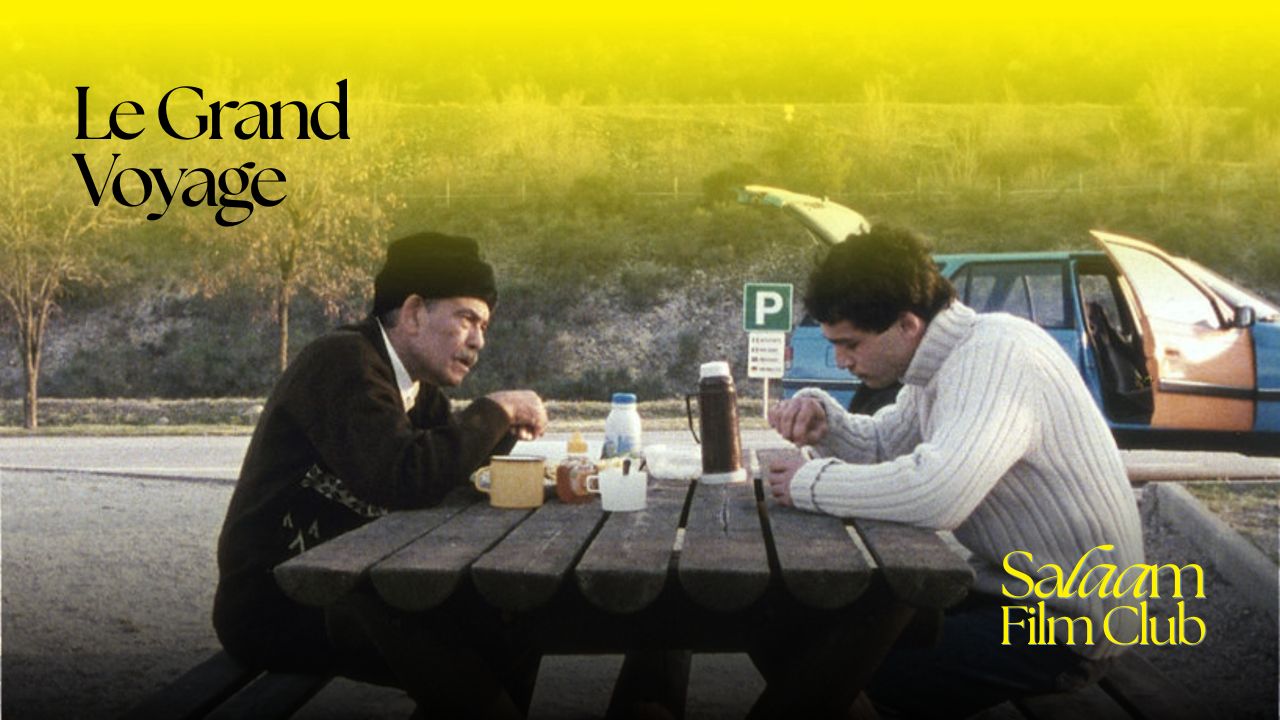

There are films that tell you a story, and then there are films that quietly invite you to take the journey alongside their characters. Le Grand Voyage, screened at Salaam Film Club, belongs to the latter.
Early in the film, while travelling through the snow, Reda asks his father why he chose to drive all the way from France to Makkah when they could simply have taken a flight like everyone else. His father’s response captures the spirit of the film and perhaps the meaning of pilgrimage itself:
“When the waters of the ocean rise to the heavens, they lose their bitterness to become pure again.”
He explains that the longer and harder the journey, the greater its value: better to travel on foot than on horseback, on horseback than by car, by car than by boat, and by boat than by plane.
That exchange sets the tone for Le Grand Voyage, Ismaël Ferroukhi’s extraordinary 2004 road movie about a father and son who could hardly be more different.
Reda is a French-born teenager living in southern France. His father is a deeply religious Moroccan immigrant who has decided to undertake Hajj by road. When his elder son cannot make the journey, he asks Reda to drive him. For Reda, the journey is far more than an interruption to his exams, his relationship with his girlfriend and the life he has built for himself. It also means spending weeks on the road with a father with whom he shares little warmth or intimacy. They live under the same roof, but there is a deep emotional distance between them. For his father, it is a pilgrimage, a deeply spiritual obligation and perhaps something far more personal.
There seems to be almost nothing that the two have in common.
And yet, they set out together.
What follows is a journey across seven countries, but the film is less interested in the geography of the route than in the emotional distance between its two travellers. The road becomes a space in which a father and son, who hardly speak to each other about anything, are forced into each other’s company.
Their differences surface constantly.
Reda drives too fast. His father reminds him that “those who hurry are already dead.” Reda is furious when his father throws away his mobile phone, cutting him off from his girlfriend. He wants to stop and see the cities they pass through, while his father insists that they are not tourists. His father prays five times a day and reads the Quran; Reda waits impatiently.
There are arguments, misunderstandings and moments of genuine frustration. They sleep in the car during a snowstorm, deal with border crossings, encounter strangers and face setbacks that make an already difficult journey harder.
Yet these obstacles are also what slowly begin to change their relationship.
The film never turns the father into a perfect, all-knowing figure or Reda into a caricature of the secular young Muslim. Both are flawed. Both misunderstand each other. The father’s faith is firm, but his ways can be rigid. Reda is impatient and dismissive, but beneath his frustration is a young man trying to understand a world that has largely been kept at a distance from him.
One of the most moving moments comes after Reda brings a dancer to their hotel room and his father discovers him. Reda struggles to apologise, eventually asking in anger whether his father’s religion does not teach him to forgive. His father does.
It is a small moment, but it says something important about the relationship between faith and people. The film does not preach it. It allows the moment to speak for itself.
As the journey progresses, Reda’s position begins to shift. When they eventually connect with a caravan of Muslim pilgrims, he finds himself among people who share the faith he has spent much of the journey resisting. And then they reach Makkah.
The sight of thousands of believers gathered for Hajj overwhelms him. For perhaps the first time, the world that his father inhabits becomes visible to him on an immense scale.
The journey has not transformed Reda into his father. Nor has it erased the differences between them. What has changed is their ability to see one another.
That, ultimately, is what makes Le Grand Voyage so powerful. Beneath the pilgrimage, the road trip and the questions of faith is a deeply human story about a father and son learning to understand, tolerate and accept one another despite their different worldviews.
Our Salaam Film Club experience


I had first watched Le Grand Voyage in 2014. Watching it again years later, and then having the opportunity to screen it for a group of people who shared my enthusiasm for both films and faith, felt particularly meaningful. The film lends itself naturally to collective viewing and conversation. It does not simply give you answers. It leaves you with questions about faith, family, migration, generational differences, the meaning of pilgrimage and the journeys we undertake with the people closest to us.
Perhaps the most beautiful thing about the film is that the physical journey and the emotional journey mirror each other. As the kilometres between France and Makkah disappear, the distance between father and son slowly begins to close.
The film begins with two people who seem to have little in common, travelling because one has to. It ends with the possibility that sometimes, the journeys we resist most are the ones that bring us closer to understanding the people we thought we knew.
By the end of the film, there were tears in the eyes of almost everyone in the room. What stayed with me even more were the conversations that followed. One after another, people began sharing moments with their own fathers: memories, disagreements, journeys, things left unsaid, and small moments that had stayed with them.
And perhaps that is why Le Grand Voyage remains such a fitting film for a film club centred on Muslim stories and experiences.
It reminds us that a journey to a sacred place is not always only about reaching the destination. Sometimes, the real journey is what happens between the people travelling together.