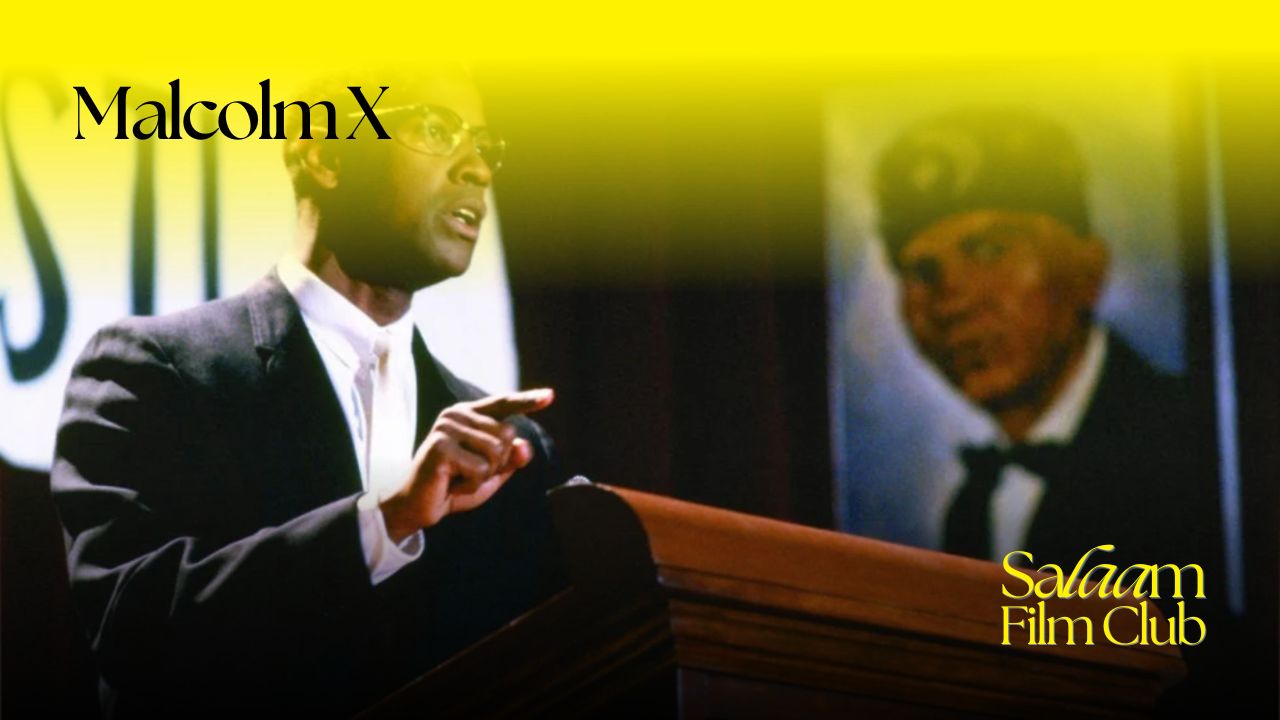

Spike Lee’s Malcolm X is built on The Autobiography of Malcolm X, co-written by Malcolm and Alex Haley. The film runs over three hours and moves through the man’s life in three distinct movements: the wayward youth, the prison conversion, and the public activist and pilgrim. It ends where Malcolm’s life ended, at the Audubon Ballroom in Manhattan on February 21, 1965.
Part One: Malcolm Little
The film opens in Boston and Harlem in the 1940s, with Malcolm Little as a young man drawn into hustling, numbers running, and petty crime, dressed in the zoot suits of the era. He works as a shoeshine boy, then drifts into nightlife and street life alongside his friend and partner in crime, Shorty. This section shows him relaxed into a world of dance halls, drugs, and small-time hustling, a life shaped by a Black youth with few paths open to him in a segregated, hostile America.
His childhood is folded into this section too. His father, a preacher and follower of Marcus Garvey who preached Black pride and separation from white society, is killed when Malcolm is a boy, in circumstances the family believed to be a racially motivated murder rather than an accident. His mother, unable to hold the family together afterward, has a breakdown and is institutionalised, and the children are separated into different homes.
This first act ends with Malcolm’s arrest, alongside Shorty, for a string of burglaries. He is sentenced to years in prison.
Part Two: Prison and Conversion
In prison, Malcolm is shown as angry, defiant, and hostile to religion, refusing even to say the word “God.” A fellow inmate, Baines, introduces him to the teachings of the Nation of Islam and its leader, Elijah Muhammad, whose doctrine holds that white people are, by nature, morally corrupt, and that Black people must reclaim knowledge of self, discipline, and separation from white society.
The film shows Malcolm’s transformation from here: he begins to read obsessively, working through a dictionary in his cell to rebuild his vocabulary, and immerses himself in history and philosophy. He renounces his old life, adopts the “X” in place of the surname passed down through slavery, and, on his release, becomes a minister for the Nation of Islam.
Part Three: Minister, Husband, Pilgrim
Malcolm rises quickly within the Nation of Islam, becoming its most visible and effective spokesman. The film shows him building mosques and membership, sparring publicly with journalists and law enforcement, and organising after incidents of police violence against Black citizens, including a real-life-inspired standoff outside a hospital where Malcolm mobilises Nation of Islam members to face down police after a member is beaten.
Alongside this, the film follows his marriage to Betty Shabazz, and the family life they build together as his public profile grows.
As Malcolm’s fame outpaces that of Elijah Muhammad, tension builds inside the organisation. The film shows Malcolm learning of Elijah Muhammad’s affairs with young secretaries within the organisation, a discovery that conflicts with the moral teachings the organisation preached. Combined with internal jealousy over his prominence, this leads to Malcolm being silenced and then separated from the Nation of Islam in 1963.
Malcolm then travels to Makkah to perform the Hajj pilgrimage. There, the film shows him praying and eating alongside Muslims of every race and skin colour, an experience that reshapes his understanding of race and religion. He returns to the United States with a broadened message, no longer preaching separatism but a more universal call for human rights, while continuing to insist on Black self-determination “by any means necessary.”
The Final Act
Back home, threats against Malcolm escalate. His house is firebombed while his wife and children are inside. The film builds toward his final public address at the Audubon Ballroom, where, as he begins to speak, he is shot and killed by gunmen tied to the Nation of Islam he had once led.
The film closes not with Malcolm’s death alone, but with a coda: classrooms of children around the world, and finally Nelson Mandela, standing before a class in South Africa, reciting Malcolm’s words, “by any means necessary,” to a new generation.
The Man Behind the Film
What the film traces, start to finish, is a man remade three times over: from Malcolm Little, a product of the streets and a broken family, to Malcolm X, the Nation of Islam’s fiercest voice against white supremacy, to El-Hajj Malik El-Shabazz, a pilgrim whose views on race had opened outward by the time of his death. Denzel Washington plays all three versions of the man across the film’s runtime, tracking a single life that moved from crime to conversion to a wider, more universal politics before it was cut short at the age of 39.